
Church History

ARCHDIOCESE OF SAN FRANCISCO
CHANCERY OFFICE
1100 FRANKLIN STREET
SAN FRANCISCO 9, CALIF.
November 14, 1952
Rev. William P. Kennedy
500 W. Granger Avenue
Modesto, California
Dear Father Kennedy:
I am happy to learn of the splendid progress you are making with your plans to construct a Church and Hall in your new Parish.
You and the devoted people in Our Lady of Fatima Parish are to be commended for your prudence and resolution in proceeding at once with the essentials of a parish building program. Throughout the history of our State, and indeed, our nation, the raising of an altar to Almighty God has ever been among the first labors of a new community. Devoted to Our Blessed Mother in one of Her most moving apparitions to mankind, your new church will offer precious opportunities for the devotions of the Faithful. I am entirely confident that the people of Our Lady of Fatima Parish will do their part unstintingly in realizing your plans for their spiritual welfare.
With my prayers for the blessings of God upon you and your people, and especially upon this campaign for the Church Building Fund, I am.
Faithfully yours in Christ
JOHN J. MITTY,
Archbishop of San Francisco


Building for Now and Tomorrow
We seek for the city that is to come HEBREWS 13:14
It’s a SHORT, SHORT STORY up to now – the history of the Parish of Lady of Fatima.
But it is the story of a year’s solid achievement, of creating a strong foundation for a
glorious future. Institution of the Parish and the well-ordered plans for its growth form
one segment of a community design that will made Modesto, within a few years, the
civic, commercial and cultural focus for 70,000 people. The Church is not behind in its
part of that future.
Such planning is not new in the eighty years of Modesto’s life. The city stands today in an area rich in potential gifts of almighty god, but man’s ingenuity had to be applied for many patient years before those gifts could be realized in bountiful and unfailing harvests, and in opportunities for gracious living for thousands of families.
Modesto’s plans call for investment of today’s prosperity in a better tomorrow. They look for continued progress of the kind which has brought millions of new residents to California, many thousands of them to Stanislaus County, since 1940.
One of those plans took definite form on October 1, 1951, when Father William P. Kennedy arrived in Modesto from San Francisco, carrying under his arm a small altar stone and the mission to establish a new Parish. The Archdiocese of San Francisco had noted Modesto’s growth, noted that the old and beloved Parish of St. Stanislaus needed help in its care for souls, and ordered the establishment of Our Lady of Fatima Parish to serve the convenience and needs of the growing number of Catholic families in the newer residential areas, then about 200. The Parish now includes about 900 families.
When Father Kennedy arrived in town and set out for his new charge the Parish plant was represented by a vacant nine acre tract on Sunrise and Norwegian Avenues, purchased a few months earlier by the Archdiocese for $16,000. Within a day or two, Father Kennedy set up his temporary in the home of William Marchington at 1228 Nelson Avenue. His next quest was a building in which he could celebrate Holy Mass and he found one in the Sylvan Club, within the Parish boundaries. In this center, at McHenry Avenue and Sylvan Road, the new Parish began to function. Two Masses were celebrated on Sunday, beginning October 14, 1951, with catechism classes on Sunday morning. Here also instructions were given to children preparing for their First Holy Communion. And on the day after celebration of the first Mass, Father Kennedy called an open meeting of the Parish at the club to plan for the future.
While plans matured for permanent buildings, Mass was celebrated in Sylvan Hall,
furnished and decorated by the Fatima Guild and the men of the Parish.

Pastor and Parish in United Effort
"Be you yourselves as living stones, built thereon into a spiritual house." -1 ST. PETER II, 5
FIRST THINGS CAME FIRST. The opening meeting agreed that a temporary Rectory
should be purchased at once. When a permanent Rectory should be built, the temporary
building would be placed on the market. The a Parish Advisory Committee was formed, to
assist the Pastor as Parish organization took form. Next the women of the Parish organized
the Fatima Guild, with a broad program of useful works.
Within short order, Father Kennedy had a strong five-man Advisory Committee, comprising top business and professional men of the Parish. Every move of the past year has been carefully weighed and planned by this group. It soon become evident that the original nine-acre site on Sunrise Avenue had some disadvantages from the parishioner’s viewpoint. Chief of these was its location near the Modesto Irrigation Canal, which some parents regarded as dangerous for young children.
Father Kennedy negotiated for its resale with the Chancery, and soon found a buyer at a price of $18,000. Everybody was happy, since this sale repaid the original purchase price plus interest payments and brought the Parish out of financially whole. Then, with the concurrence of the Advisory Committee, the Parish bought a plot of eight acres on West Granger Avenue, direct in the path of Modesto’s growth and convenient both to downtown and to all sections of the new parish. This purchase, concluded in December 1951, involved a commitment of $29,000.
Directly across the street from the new Church site, Father Kennedy took advantage of an opportunity to buy a new house at 400 West Granger Avenue for $11,000. That was in January, 1952, and it provided the temporary Rectory. The Fatima Guild raised enough money through card parties, rummage sales, etc. to furnish and decorate the Rectory, which the Pastor occupied on April 1.
The men of the Parish had in the meantime built an altar in the Sylvan Club as well as kneelers and other temporary conveniences for worship. Both the Fatima Guild and the Advisory Committee met frequently during the year in the rumpus room at the home of Charles Tocalino, at 1625 Magnolia Avenue.
With the Rectory problem solved for the immediate future, the next important steps was provision for a temporary Church. After considering many plans, the Pastor and Advisory Committee found that the simplest form of temporary building would cost $90,000. That did not look like a prudent investment, and Father Kennedy, with the committee, took further thought. In consultation with Vincent Raney, the San Francisco architect, plans for a permanent Church were developed. The committee agreed that it would be good business to add $100,000 to the $90,000 already considered and thus provide a Church that would serve the Parish for the long future.
The little altar stone that Father Kennedy brought from San Francisco
rests in this simple altar, built by the men of the Parish in 1951.


The little altar stone that Father Kennedy brought from San Franciscorests in this simple altar, built by the men of the Parish in 1951.
Memorials
"Let these things be written for another generation: and the people that shall
be created shall praise the Lord." -PSALM CL, 19
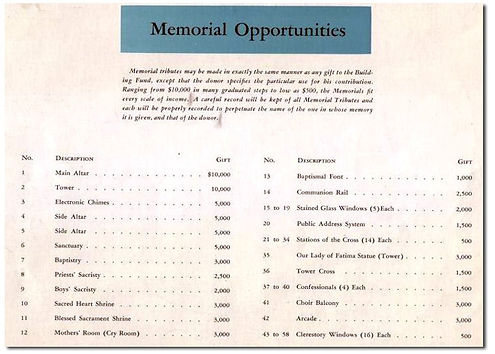
GIFTS TO THE BUILDING FUND of Our Lady of Fatima Church may be applied to
the creation of Memorials to departed loved ones. On the next page of this booklet
\is a floor plan of the new Church and Parish Hall; facing it, a list of Memorial Opportunities.
A gift of any sum designated in that list may be assigned as a Memorial to honor a deceased
Father or Mother, a beloved child, or a friend of earlier years. For the next generation, at least,
this Church will be a center for the devout moments of many thousands. The Hall will see many assemblies for recreation and for works of piety and charity. What more fitting surroundings can there be for reminding parishioners of years to come that those who have gone before them still share, and wish to share, their prayers and good works?
Remember these departed dear ones when one of your fellow parishioners calls upon you during the next few days for your contribution to the Building Fund. Hear his message with attention, for it is of great moment to you and your family. Your visitor will have already made his gift to the Building Fund. He knows the answers to questions you may wish to ask. Ask them. Then make as generous a gift as you can. Remember that this is not a recurring annual appeal for community charities; it is a capital investment for your immediate spiritual good and your temporal convenience. Make your giving adequate to express your love for Our Blessed Saviour and His Blessed Mother.

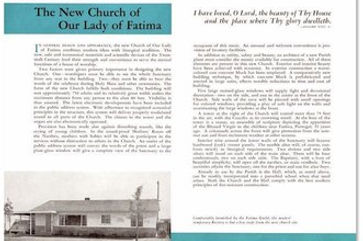
The New Church of Our Lady of Fatima
"I have loved, O Lord, the beauty of Thy House and the place where Thy glory dwelleth."
-PSALMS XXV, 8
IN GENERAL DESIGN AND APPEARANCE, the new Church of Our Lady of Fatima
combines modern ideas with liturgical tradition. The new, safe and economical materials
and scientific devices of the Twentieth Century lend their strength and convenience to
serve the eternal functions of a house of worship.
Two factors were given primary importance in designing the new Church. One – worshipers must be able to see the whole Sanctuary from any seat in the building. Two – they must be able to hear the words of the celebrant during Holy Mass and other ceremonies. The form of the new Church fulfills both conditions. The building will seat approximately 750 adults and its relatively great width makes the maximum distance from any person to the altar 80 feet. Visibility is thus assured. The latest electronic developments have been included in the public address system. With adherence to recognized acoustical principles in the structure, this system will deliver properly modulated sound to all parts of the Church. The chimes in the tower and the organ are also electronically operated.
Provision has been made also against disturbing sounds, like the crying of young children. In the sound-proof Mother’s Room off the Narthex, mothers with babies will be able to participate in the services without distraction to others in the Church. An outlet of the public address system will convey the words of the priest and a large plate-glass window will give a complete view of the Sanctuary to the occupants in this room. An unusual and welcome convenience is provision of lavatory facilities.
In the addition to utility, safety and beauty, an architect of a new Parish plant must consider the money available for construction. All of these elements are present in this new Church. Exterior and interior beauty have been achieved with economy. In exterior construction warm-colored cast concrete block has been employed. A comparatively new building technique, by which concrete block is prefabricated and erected in large units, effects notable reductions in time and cost of building.
Five large stained-glass windows will supply light and devotional decoration – two on the side, and one in the center at the front of the Church. Side walls of the nave will be pierced with small openings for colored windows, providing a play of soft light on the walls and accentuating the large windows at the front.
A tower at the right of the Church will extend more than 75 feet in the air, with the Crucifix as its crowning motif. At the base of the tower is a statue, an ensemble of sculpture depicting the apparition of the Blessed Virgin to the children near Fatima, Portugal, 35 years ago. A colonnade across the front will give protection from the summer sun and from inclement weather at other seasons.
Interior trim around the lower walls of the Sanctuary will feature hardwood (oak) veneer panels. The marble altar will, of course, conform strictly to liturgical requirements. Two shrines and two side altars will stand on each side of the main altar. There will be four confessionals, two on each side aisle. The Baptistry, with a font of beautiful simplicity, will open off the narthex, or main vestibule. Two sacristies adjoin the Sanctuary, one for the priest and one for altar boys.
Already in use by the Parish is the Hall, which as noted above, can be readily incorporated into a parochial school when that need arises. Both the Church and the Hall comply with the best modern principles of fire-resistant construction.
Comfortably furnished by the Fatima Guild,
the modest temporary Rectory is but a few steps from the new church site.
Building Campaign

Building Campaign Front Page

Church Building Fund Committee

Memorial Tributes
Our Lady of Fatima Church designs by architect Vincent G. Rancy


Depth and dignity in simple design of Church interior
Beauty and piety blend in new Church of Our Lady of Fatima
Church Windows
Looking at the dominant window colors
- the red, the gold, the green -
they are of the cross, the comforting cross.
Window of the rising sun
At sunrise when a flash falls across the travertine wall (in the direction of the St. Joseph image) it also draws attention to the east window, such that during the day when people are about to exit from the church they often pause and beginning at the window farthest from the travertine wall they observe four window movements, the last of them to continue to a degree beyond the exit side-door.
The first movement - Mount Sinai-wise - speaks of the Israelites rising from table, the table from which they had eaten a sacrificial meal, a meal that spoke of where they stood with God and the relation of the Passover to the Eucharist of the far future. The second window movement tells of the Passover meal to which Jesus with his chosen disciples had come and were now rising form the table - Jesus to move to his cross, they (with the exception of Judas who had already left and sold Jesus) to their cross. Incidentally, the cross - somewhat slanted - for Jesus and the eleven are beginning to appear in the window glass. But for the exception of the beloved disciple to whom Jesus was to speak from the cross - in truth the temporary head of the Church - all the others scattered, to remain so until the resurrection. The third movement is Sunday Mass. As we move, to arrive and enter into the action we become part of all that went before us, to the paschal and Last Supper meal of bread and wine, even remotely to Sinai. But we are also at the threshold of the heavenly future. The fourth movement speaks of the end-time. Here Jesus is welcoming - as it were at table - the redeemed souls already in heaven, and given the resurrection of their bodies at the end time, this joy in heaven - if one may say so - become intensified.
In a sense, to contemplate the window of the rising sun can leave us breathless.
Window of the setting sun
True, and speaking antecedently of the setting sun, four window movements tell of an imperfect Church. In contrast to what will be the perfect Church at the end of time, of the four movements there are clearly self-centered - the border - line young, the older teenagers, the adult-like young men and women - and to that extent all are of the Church imperfect.
As for the fourth window movement that on the surface seems perfect, on reflection, however, it is the constant teaching of the Church that no one is confirmed in grace.
But the question at this stage that remains to be asked and answered of the imperfect Church is whence the future? Scarcely but a matter of a few feet away and reaching down to the floor are the two chapels of reconciliation (confessionals), such that the occupant to departing emerges frequently with a light heart.
Thoughtfully, in that the horizontal windows of the church have a rhythmic beat to them - a provision foreseen in the planning stage of the church - that with the unavoidable stations of the cross - all regularly arranged on either side of the church - and the chapels of reconciliation, both re-enforcements of the window or windows above, windows that deserve protections from any well-meaning, addition form below.
